
Renton Previous Resident Sources
A backward address search works best when each source is assigned a job. The current parcel fixes the site on the map. Recorded instruments supply dated party names and legal descriptions. Archive cards add details about the building, while city directories and newspapers can place a household at the address during a particular year. None is a complete resident roll.
| Source | Time span | Keeper | Best clue |
|---|---|---|---|
| Assessor, Parcel Viewer, city GIS | Current, changing systems | King County and Renton | Parcel ID, situs, boundary, legal description |
| Landmark parcel search | Generally 1997 to present | King County Recorder | Instrument, parties, date, document number |
| Landmark name and legal search | August 1, 1991 onward | King County Recorder | Grantor, grantee, book/page, legal text |
| Recorded microfilm and originals | 1853 through July 1991 | King County Archives | Older deeds, plats, mortgages, easements |
| Real Property Record Cards | About 1937 to 1972 | County or State Archives | Photo, footprint, construction, sale and value clues |
| Renton and regional directories | Selected years from 1882 to 2009 | State Library, KCLS, Museum | Dated names, addresses, phones and household notes |
Start with the row closest to the target year, then confirm its result in a different kind of record. A tax-roll owner is not necessarily an occupant. A directory listing may be a household, business, institution, boarder, or telephone subscriber. That distinction keeps a previous-residents timeline honest.
Anchor Renton Records to Parcels
The stable starting key is the ten-digit parcel number. Search the complete address in King County Parcel Viewer, compare any candidates, and save the situs address, legal description, plat or lot-and-block text, and mapped jurisdiction. Situs means the physical location. It differs from the tax mailing address, which may point to a post office box, representative, estate, or business.
Open the linked assessor report and eSales view when available. Record labels and dates exactly. Current owner, sale history, value, and building fields are leads, not proof that a named person lived at the site. Condominiums need special care because a master or common-area parcel will not name every unit occupant. The full present-day address workflow belongs in the Renton street directory; here the parcel serves as the first rung in a past-resident trail.
Note: Keep the legal description even when the street address looks clear, since it can survive renaming, renumbering, and annexation.
Walk Renton Resident Deeds Backward
The King County Recorder's Landmark index supports several paths, but its dates matter. Parcel searching generally reaches from 1997 forward. Online records begin earlier, on August 1, 1991, so the 1991 through 1996 bridge may require party names, dates, book and page, document type, or legal-description terms instead of a parcel-only query.
- Capture the current parcel, legal description, and likely transfer date from assessor and sale records.
- Find the newest purchase deed in Landmark. Save its instrument number, date, parties, image status, and printed legal description.
- Take the seller named as grantor and search that party as a grantee, the person or entity receiving an earlier interest.
- Repeat while matching legal descriptions. Do not treat a lien, easement, deed of trust, or reconveyance as a title transfer.
- At the online boundary, request the older index, microfilm, or original through King County Archives.
- Grantor and grantee
- The grantor gives or transfers an interest; the grantee receives it.
- Chain of title
- The dated sequence of instruments connecting one recorded interest to the next.
- Legal description
- The formal land description, often using plat, lot, block, section, or survey terms rather than a postal address.
Use the Landmark Web index for the modern chain. Its online images are unofficial and may be watermarked. An authoritative copy comes through the Recorder's copy process. The office also warns against high-volume automated queries.
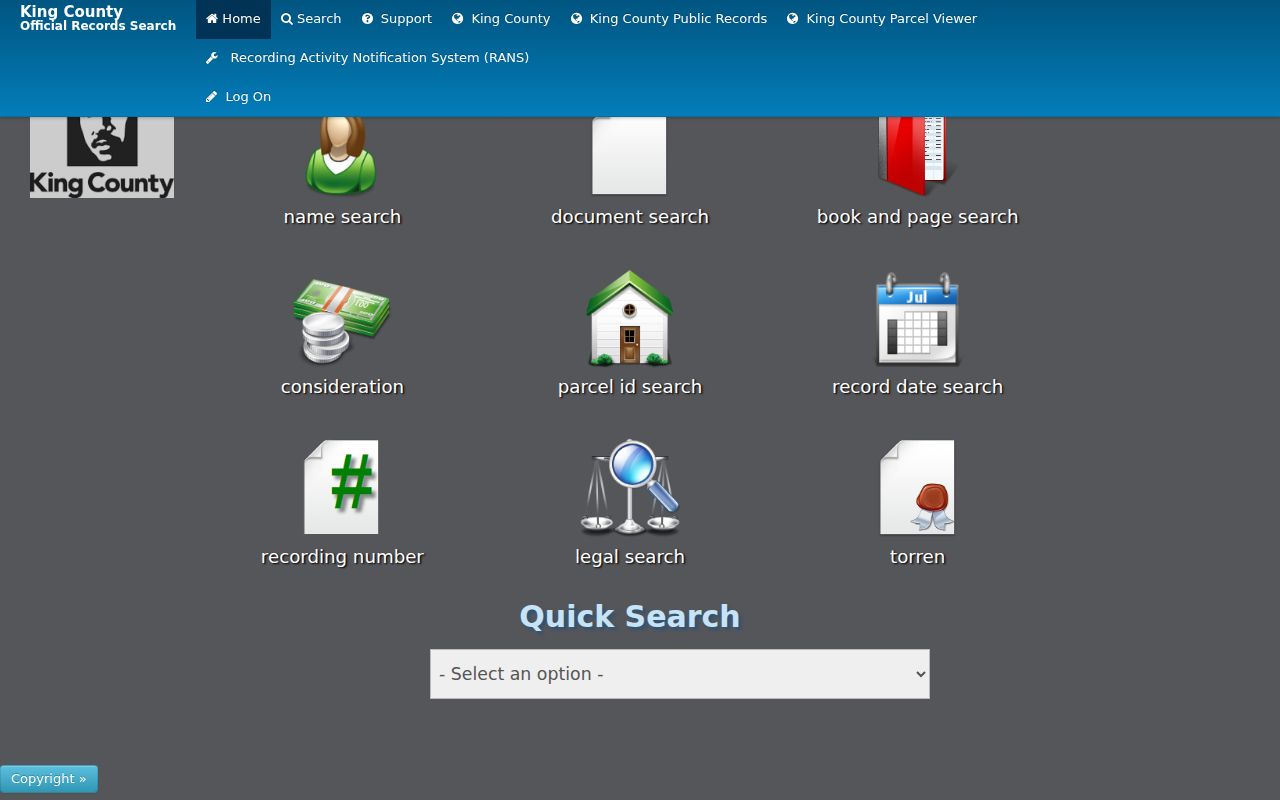
King County explains its recorded-document access routes, including the archive cutoff and copy options. The captured index screen below shows the kind of official interface used to move from a known parcel or party toward an instrument.
Renton Records Before 1991
A blank parcel result is expected when the target deed predates the online parcel mode. King County Archives holds recorded microfilm and originals from 1853 through July 31, 1991. Send a narrow request with the last known instrument, the legal description, former owner names, document type, and a bounded date range. The research room has microfilm readers and scanning options, with appointment and access details set by the archive.
Historical tax rolls can show the fee owner, legal description, assessed value, payment, and payer. Fee owner means the person or entity shown as holding the ownership interest for that roll. Real Property Record Cards from about 1937 through 1972 may show a photograph, construction facts, footprint, sale notes, and values. The Puget Sound Regional Archives adds territorial censuses, assessments, house records, and other series whose dates vary.
Request key. Ask for a collection or index citation first. A custodian can answer a focused parcel, party, and date query more reliably than a broad family-history request.
Note: If an image is missing, retain the index citation and label the absent field instead of filling it from another source.
Renton Previous Resident Property Cards
The archive cards are an unusually human bridge between land records and house history. A card can preserve the form of a building and its footprint even when later remodeling changed the site. Construction and assessment entries help explain why an address first appears in a directory or why a parcel's description shifts after a split. These cards concern property, so a photographed house must not be presented as evidence that a specific person occupied it that day.
Record the card's parcel or tax account number, situs, legal text, map or plat, land and improvement values, building facts, sales references, tax year, and any update statement. Compare those fields with a deed rather than relying on a copied summary. That extra match is useful when two Renton families share a surname or an old record uses initials.
Place Renton Previous Residents
Ownership and occupancy separate at this stage. Washington State Library lists Renton city directories for selected years beginning in 1882 and extending through 1991. South King County telephone-book holdings run in selected years from 1951 through 2009. The State Library's regular public service closed in 2025, so its current route is limited appointment or contact access rather than assumed walk-in research. KCLS Renton and the Renton History Museum supply local alternatives.
Pair a directory entry with the nearest available volume before and after it. Read both the surname section and any street or criss-cross section, an address-first list. Copy the edition, page, exact printed address, initials, telephone entry, and abbreviation key. A gap may reflect a missing issue, no telephone, new construction, changed numbering, or an editorial omission. The collections and year lists are covered more fully in the Renton city directory.
- Fix the parcel and the address spelling used during the target period.
- Request the nearest directory editions on both sides of the year.
- Copy the target house number and adjacent numbers from the street section.
- Compare names with a census, newspaper, yearbook, obituary, tax card, or probate lead.
- Write a dated conclusion and keep owner, renter, subscriber, and other roles distinct.
Lawful use. Research previous residents for house history, family history, estate work, or personal curiosity. Never use an address trail to watch, harass, intimidate, or harm a living person.
Renton Town Talk Closes Gaps
KCLS Renton holds Renton Town Talk on microfilm from October 1962 through March 1964. That short run can connect a directory name with an obituary, marriage item, school notice, club activity, or civic event. Ask library reference staff for a targeted name, date, and address search. The branch lists a microfilm and microfiche reader, though it is sensible to confirm availability before visiting.
KCLS describes its microfilm holdings and access. The source capture below represents that library route, which can supply context after an official land record yields only a party name.

Obituaries and probate files can mark the end of one resident's connection to an address, but the event date and address must be quoted as printed. The Renton History Museum also offers bound newspapers, yearbooks, maps, oral histories, city directories, and local-interest files by appointment.
Old Renton Addresses Move
Sometimes the record chain breaks while the land stays put. Road-name resolutions, historic parcel links, annexation layers, maps, and directory street sections can bridge a former name or house number. One Renton-area example followed the Benson Hill annexation: a short segment used Edmonds Avenue Southeast while a longer road used 116th Avenue Southeast. Search both names and keep the same parcel and legal description in view.
Landscape history can also make old descriptions seem wrong. Changes involving the Black River and the Montlake Cut altered familiar geographic reference points. Do not modernize an old description silently. Transcribe it, identify the map or resolution that explains the shift, and then state the modern match as a conclusion rather than as source text.
Judge Renton Resident Evidence
The strongest timeline is a row-by-row evidence ledger. For each step, record the date, source, instrument or page citation, party or listed person, role, address as printed, parcel match, legal description, image or copy status, and next lead. Mark uncertainty when an estate, trust, company, missing image, new parcel, or altered legal description interrupts the chain.
Previous residents should be described with time limits: “listed at the address in the 1963 directory” is sounder than “lived there throughout the 1960s.” Likewise, “named grantee on a recorded deed” is more exact than “resident.” When land, directory, and news records agree, the combined result can answer who lived here before without claiming more than the records prove.
Note: Save retrieval dates for live portals because assessor, permit, and map data can change after a search is completed.